
 English
 German
 French
 Russian
 Spanish
 Japanese
 Korean
 Portuguese
 Ukrainian
 Arabic
 Italian
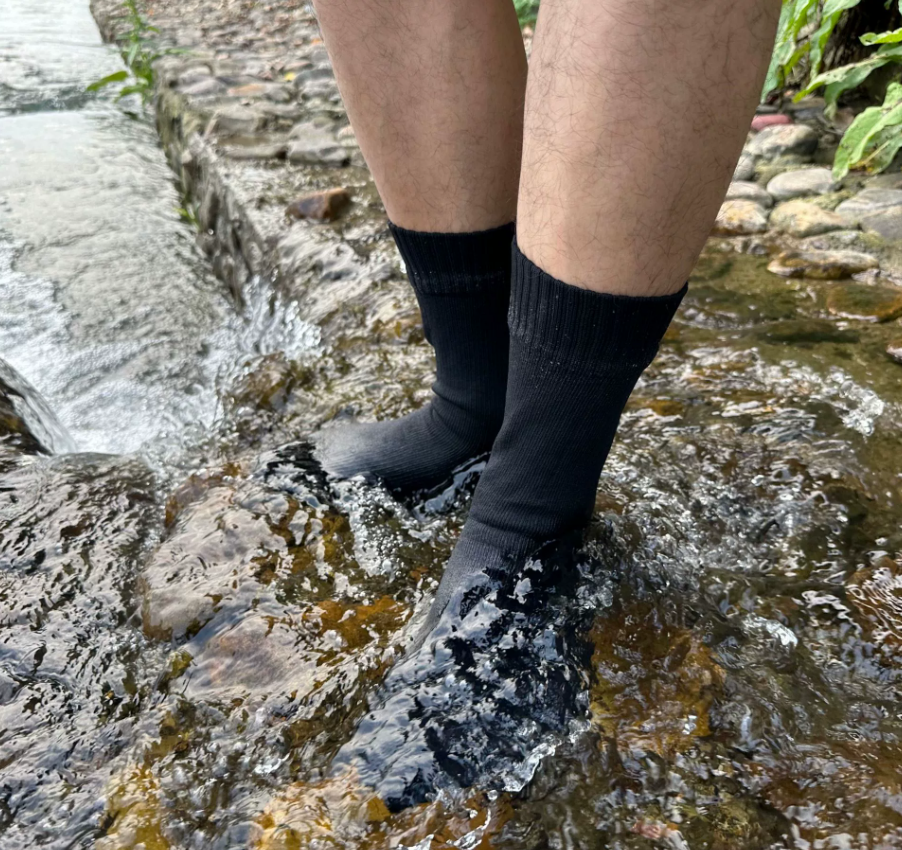
How Waterproof Socks Actually Work
Waterproof socks are not rubber socks.Most high-quality waterproof hiking socks are built using a three-layer construction:
• Outer layer: A durable knitted shell designed to resist abrasion from shoes and terrain
• Middle layer: A waterproof yet breathable membrane (commonly TPU-based) that blocks liquid water
• Inner layer: A soft,moisture-absorbing lining that improves comfort and reduces friction
The key technology is the waterproof membrane.Liquid water cannot pass through it,while water vapor from sweat can escape slowly.This balance is what allows waterproof socks to protect feet without completely trapping moisture.
Performance in Real Stream-Crossing Scenarios
Short,Shallow Stream Crossings
In most hiking situations where water stays below the sock cuff and exposure time is short,waterproof socks perform extremely well.Water is blocked from the sole and sidewalls,keeping feet largely dry as you exit the stream.
This is why many hikers prefer waterproof socks over repeatedly changing footwear on routes with frequent shallow crossings.
Water Above the Sock Opening
Once water flows in from the top,no sock can stop it.However,waterproof socks still offer a clear advantage.The membrane prevents continuous water ingress,meaning feet do not remain constantly soaked as they would in regular socks.
After exiting the water,warmth from the foot and the inner lining help restore comfort faster than standard hiking socks.
Prolonged Immersion or Strong Currents
Waterproof socks are not designed for extended submersion.High water pressure and long exposure can overwhelm the system and reduce comfort.This is not a product failure—it simply exceeds the intended use case.
Why Waterproof Socks Matter for Outdoor Performance
From a functional standpoint,waterproof socks offer several key benefits during wet terrain use:
• Reduced blister risk by minimizing prolonged skin friction in wet conditions
• Improved insulation in cold streams and damp climates
• Better moisture control compared to traditional wet socks
• Higher trail efficiency,eliminating frequent sock changes
For outdoor brands,these benefits translate into stronger product differentiation and higher perceived value.
Waterproof Socks vs.Regular Hiking Socks
It's important to set realistic expectations.Waterproof socks are not meant to keep feet perfectly dry in every scenario.Their real advantage is risk reduction—keeping feet drier,warmer,and more stable for longer periods.
For stream crossings,wet grass,morning dew,and unpredictable weather,they significantly outperform standard hiking socks.
Design Considerations for Custom Waterproof Socks
For brands developing custom waterproof hiking socks,key factors include:
• Membrane quality and durability
• Seam sealing and cuff construction
• Inner lining material for blister prevention
• Fit precision to avoid movement inside the shoe
Manufacturing expertise matters.Poor construction can negate the benefits of even the best materials.
Build Your Custom Waterproof Socks with Feelingwaysox
At Feelingwaysox,we specialize in custom waterproof socks for outdoor brands,offering full OEM and ODM support—from material selection to fit engineering and bulk production.
Whether you're developing waterproof hiking socks for stream crossings or expanding your outdoor sock line,our team helps you create products that perform where it matters most.
Partner with Feelingwaysox to turn functional design into real outdoor performance.