
 English
 German
 French
 Russian
 Spanish
 Japanese
 Korean
 Portuguese
 Ukrainian
 Arabic
 Italian
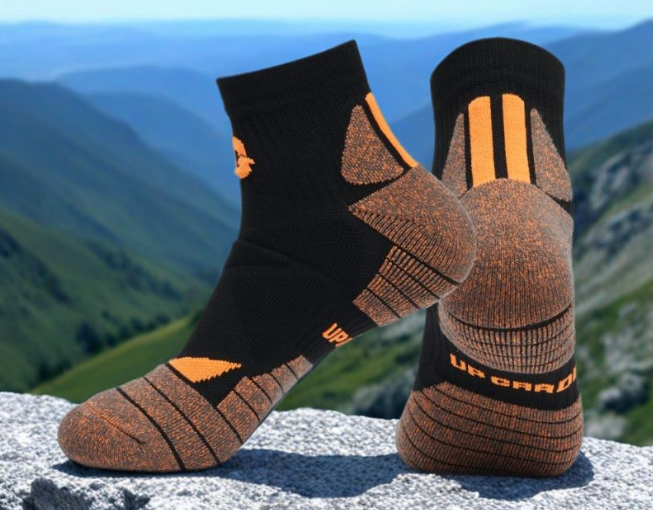
1.Designed for Different Activities
Running socks are engineered for repetitive forward motion — think road running,light trail running,or marathons.They prioritize breathability,fit,and moisture control to keep feet cool and dry during fast-paced movement.
Hiking socks,on the other hand,must handle complex terrains — rocky paths,muddy trails,and steep climbs.They're built for long wear,cushioning,and durability under sustained pressure,often inside stiffer hiking boots.
2.Cushioning and Thickness
Hiking socks are thicker,providing extra padding in the heel,sole,and toe to protect against prolonged friction and uneven ground.Many styles feature reinforced zones for added durability and warmth.
Running socks are thinner and lighter to minimize bulk and allow a closer shoe fit.They include targeted cushioning only in high-impact areas like the heel and forefoot for efficient energy return and reduced fatigue.
Think of it this way: hiking socks are your soft armor,while running socks are your aerodynamic shell.
3.Fit and Structure
Running socks often feature compression zones,arch support,and elastic cuffs to enhance stability and prevent slipping inside the shoe.
Hiking socks focus more on comfort during long hours of wear,balancing snugness with flexibility.Some designs include anti-slip cuffs or ribbed tops to prevent bunching while walking.
4.Material and Fiber Choice
Running socks usually use synthetic blends — nylon,polyester,and spandex — for lightweight,quick-drying,and durable performance.
Hiking socks often rely on Merino wool or wool blends,which naturally regulate temperature,resist odor,and wick away moisture even in damp conditions.
Avoid high-cotton socks — while soft,they retain moisture and increase the risk of blisters.
5.Durability and Reinforcement
Hiking socks are built to last,with dense weaving and reinforced zones around the heel,toe,and arch.
Running socks trade some of that toughness for flexibility and breathability,designed for performance over longevity.
6.Pairing Socks and Shoes
Thicker hiking socks take up more space inside shoes,which can cause tightness or slippage if not properly matched.Running socks,being thinner,create a more precise fit — ideal for snug running shoes.
If you plan long hikes,leave some room in your boots for swelling.For short or medium runs,a close-fitting sock helps minimize friction.
7.When to Choose Which
• Choose running socks for city jogging,gym workouts,and marathons.They keep feet dry,cool,and stable under quick,repetitive movements.
• Choose hiking socks for long trails,camping,and backpacking.Their thick cushioning and durable fibers protect your feet from blisters and cold temperatures.
• Choose hybrid styles (trail running or light hiking socks) if your adventures include both running and walking on mixed terrain.
8.Practical Tips
• Don't wear brand-new socks for a long hike — break them in first.
• Always carry a backup pair; dry socks prevent blisters.
• Avoid high-heat drying,especially for wool socks.
• Match sock height to your shoes and activity — longer socks protect against dirt and debris.
The key difference between running socks and hiking socks lies in their purpose:
Running socks → lightweight,snug,and breathable.
Hiking socks → cushioned,durable,and insulating.
Choose the pair that fits your journey — your feet will thank you.